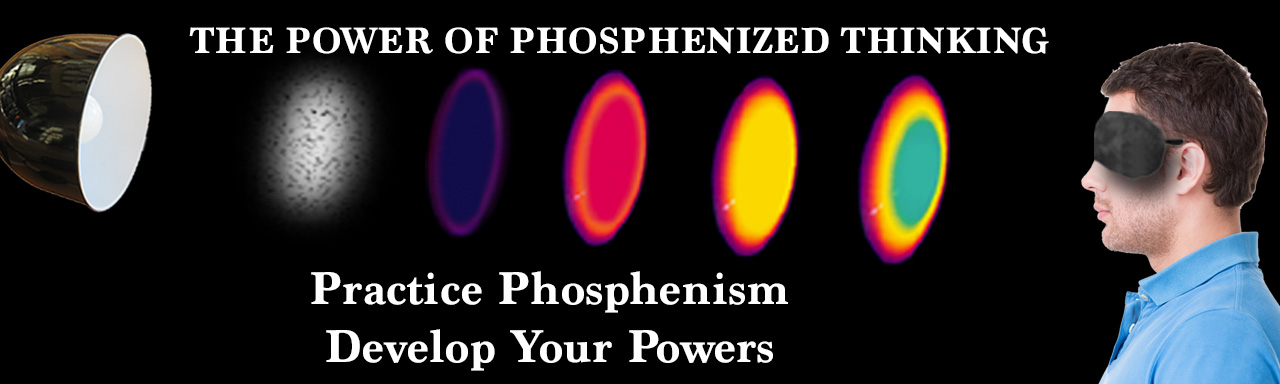
Discover the Phosphenism!
Learn how to transform Light Energy into Mental Energy!
Doctor LEFEBURE’s extraordinary discovery is that MIXING A THOUGHT WITH A PHOSPHENE ALLOWS TO TRANSFORM LIGHT ENERGY INTO MENTAL ENERGY.
That is why we can affirm that “phosphene is the key to develop brain powers like memory, concentration, intuition and the higher faculties when it is associated with certain traditional exercises.”.
Phosphenism, it is 3 application’s fields:
Education/Pedagogy:
The use of phosphenes will allow you to develop your memory and your concentration.
Because the extraordinary discovery of Doctor LEFEBURE is that mixing a thought with a phosphene transforms light energy into mental energy.
Phosphenes then provoke the development of memory, intelligence, attention and creativity.
Individual Development:
The technique of Phosphenism will allow you to develop what you are tending towards.
Because Phosphenism allows to develop the personality in “priority” by blossoming the best of each one in a harmonious originality which is expressed by creativity.
Phosphenism will allow you to have an action on your destiny.
Initiatic Research:
The true meaning of Initiation (from the Latin initium: beginning, start) is to trigger energies which will allow to realize and express the latent faculties of the individual.
Through thousand-year-old techniques analyzed by Doctor LEFEBURE under the angle of the cerebral physiology.
Phosphenism is based on more than 60 years of experimentation
and several tens of thousands of practitioners in the world.
DR. LEFEBURE’S METHOD & DISCOVERIES
For thousands of years, sways have been practiced in many traditions and initiatic teachings in order to develop powers and provoke the awakening of consciousness.
In 1959, Dr. LEFEBURE discovered a new way to perform head sways which is much more powerful.
Lateral head sways
with a focusing point
=
Intuition, Telepathy,
Personality building,
Stress reduction, etc…
Note: Use a PC or a Mac to watch ALL video animations
which are contained into pages of the METHOD section.
Understand the practice thanks to our 27 video animations:
• 4 for Education + 18 for Individual Development
+ 5 for Initiatic Research
.
HEAD SWAYS: You only have to look around you to understand the importance and the interest of sways. All children love to sway, just as the mother spontaneously cradles her child. Why else, if not for this physiological necessity emphasizing a rhythmic function of the brain?
All too often, parents prohibit the child from swaying because they don’t know the importance of sways. Children feel this instinctively and know how to listen to their deep cerebral rhythms, which is not the case for adults who, later, try to find this universal initiatic path.
INITIATION, under its various aspects, consists essentially of the subtle energies awakening thanks to the sways practice, provoking awareness and high psychic phenomena.
Dr. LEFEBURE, thanks to his research in cerebral physiology, demonstrated the deep link between certain traditional practices and curious physiological phenomena whose nobody understood the origin or the nature. Therefore the real process of initiation is now being updated, thanks to him which makes it accessible to all.
The focusing on direct or indirect light sources and sways are at the origin of all initiations and are found in all traditions. So, it is this focusing and, consequently, the resulting phosphene which develop the powers of the mind.
It goes against the belief that such abilities are “reserved” for certain chosen ones called Initiates because they are aware of the true nature of Human Beings.
In fact, there are very easy to obtain and develop, as long as a few simple rules are followed; laws that we will reveal to you throughout your discovery of Phosphenism.
Phosphenism is the rediscovery by Doctor LEFEBURE of an ancestral practice common to all humanity. Actually, in the past of human history, its practice was reserved for an elite in order to develop their powers. But today, the vocation of PHOSPHENISM Publishing and Dr. LEFEBURE School is to offer this knowledge to all mankind.
Practice PHOSPHENISM, it is learn how to transform Light Energy into Mental Energy.
Definition: PHOSPHENISM is a system of techniques developed by Dr. LEFEBURE, whose purpose is to increase brain capacity using a method based on physiological reactions called “phosphenes”, which are multicolored spots appearing in the dark of closed eyes during several minutes and which result from the focusing on a light source during several seconds.
Phosphenism, its effects are no longer to be proven, but to be discovered.
So, you too, enter into the Phosphenism Universe
AND DISCOVER DR. LEFEBURE’S METHOD
Subscribe to our newsletter and receive for free:
– The e-Book “THE EFFECTS OF PHOSPHENIC MIXING APPLIED TO EDUCATION” in .pdf format
– The PHOSPHENISM COURSE IN 10 LESSONS, at a rate of one lesson per day for 10 days.
And so much more…
Because, after the last lesson of this course, you will continue to receive, many advices on the practice of Phosphenism in its 3 fields of application:
• EDUCATION • INDIVIDUAL DEVELOPMENT • INITIATIC RESEARCH
With my warmest encouragement to the practice of Phosphenism,
Daniel STIENNON*
(Director of the Dr. LEFEBURE School)

Light, source of knowledge, is the open door to an exciting inner adventure.
Receive free informations about the practice of Phosphenism.
To view the Tables of Contents of what you will receive:
Table of contents: Course in 10 Lessons
Do you know …
Lesson #01 – How to quickly find a solution to a problem that concerns you?
Lesson #02 – How to quickly find a solution to a problem that concerns you? (follow-up)
Lesson #03 – What was the quality of your thinking?
Lesson #04 – Were you able to keep a single thought in your mind?
Lesson #05 – Mental emptiness, a meaningless concept!
Lesson #06 – Phosphenic Mixing’s practice.
Lesson #07 – Enhance your thinking!
Lesson #08 – Develop your reflection!
Lesson #09 – Develop your reflection! (follow-up)
Lesson #10 – The obviousness feeling.
Table of contents: Education
Do you know …
01 – …that light is a powerful natural stimulant?
02 – …that light has a very great influence on hormonal functions?
03 – …how to make a Phosphene?
04 – …that Phosphenic Mixing increases intelligence?
05 – …how to proceed to read with phosphenes?
06 – …that the Phosphenic Mixing allows you to relax without pain?
07 – …why does the baby or child calm down when rocked?
08 – …that the Phosphenic Mixing has a great action on the initiative spirit?
09 – …that the practice of Phosphenic Mixing improves social relations?
10 – …that one of the most curious effects of Phosphenic Mixing…
11 – …that the Phosphenic Mixing acts on intelligence?
12 – …that the Phosphenic Mixing allows personal development?
13 – …that the secret to success is rhythm?
14 – if your brain alternation is regular?
15 – …how does learning work? (1/2)
16 – …how does learning work? (2/2)
17 – …that the conception that many people have of concentration is a misconception?
18 – …how does the Phosphene act on the thought during the Phosphenic Mixing?
19 – …that the Phosphene responds to the law of all or nothing?
20 – …how to proceed to facilitate falling asleep and recovery?
21 – …that hypnotic practices are the opposite of phosphenic techniques? (1/2)
22 – …that hypnotic practices are the opposite of phosphenic techniques? (2/2)
23 – …that the Phosphenic Mixing allows dyslexic and dysorthographic troubles to disappear?
24 – …how to proceed to improve spelling?
25 – …how to proceed to fix dyslexia and dysorthographia?
26 – …how to proceed to add the alternophone to the Phosphenic Mixing exercises?
27 – …that the use of alternative hearing makes it possible to amplify all the results of any practice?
28 – …that the alternophone can advantageously be used in various circumstances?
29 – …that alternative hearing have a positive effect on down syndrome?
30 – …that, thanks to alternative hearing, we can momentarily relieve various discomforts?
31 – …that focusing on a detail of the Phosphene allows a real psychoanalysis?
32 – …that Tinnitus is the equivalent of Phosphene in terms of hearing?
33 – …that there is the equivalent of Phosphenes with all the sensory functions?
34 – …how to proceed to develop a theme for an assignment, a reflection or an essay?
35 – …how to proceed to increase the ability of ideation?
36 – …how to proceed with the “cascade questions” technique with tinnitus?
>37 – …that to revive the attention, you just have to make a phosphene?
38 – …how to proceed to study of mathematics with phosphene?
39 – …how to proceed to learn mathematical formulas?
40 – what is phosphenic antifouling?
41 – …how to proceed to work with superphosphene?
42 – …how to proceed to memorize a long text or a long chapter of history?
43 – …how to proceed to study a foreign language?
44 – …how to proceed for grammar rules?
45 – …that we can make phosphenes with various light sources?
46 – …what it is like to become a sun in society?
47 – …that it is our last newsletter about this theme?
Table of contents: Individual Development
Do you know…
01 – …that the Phosphenic Mixing has been used instinctively by all peoples?
02 – …that the sways are found in most of the religions?
03 – …that we can improve the cerebral alternation thanks to head swings?
04 – …what is the most favorable manner to practice antero-posterior head sways?
05 – …that we can achieve the exteriorization of the luminous double thanks to the head sways?
06 – …that the antero-posterior head sways leads to wakefulness in sleep?
07 – …that the rhythmic thinking has a moralizing action?
08 – …what are the effects of thinking associated with sun-focusing?
09 – …that Fasting is to digestion what Pneumophene is to breathing?
10 – …how to proceed to practice Mixing with the Pneumophene? (1/2)
11 – …how to proceed to practice Mixing with the Pneumophene? (2/2)
12 – …how to proceed to use Pneumophene in the interpretation of dreams?
13 – …what is the breadcrumb trail of the obviousness feeling?
14 – …that the free prayer associated with sun-focusing is the highest spiritual exercise we can do?
15 – …that it is possible to practice phosphenic telepathy with animals?
16 – …that the effects of Phosphenism are the opposite of those of drugs?
17 – …that hyperpnea can be considered as a drug?
18 – …what is the relationship between the words « Phosphenes » and « Emerald »?
19 – …what is the relationship between the Mysteries of Eleusis and Phosphenism?
20 – …what were the Mysteries of Eleusis?
21 – …that there is a sublimation of the sexual forces thanks to the Phosphenic Mixing?
22 – …how to proceed to achieve this sublimation of sexual forces?
23 – …that we can magnetize water with phosphene so that it has healing properties?
24 – …that the Solar Prodigy of Fatima took place in front of 70.000 people?
25 – …how could Fatima’s children handle so perfectly with instinct this tremendous phosphenic force?
26 – …what is gyrophene?
27 – …what is “Green Ray”?
28 – …how to proceed to experimentally reproduce the “Green Ray” ?
29 – …that a prayerful crowd is better than a Guru? (1/2)
30 – …that a prayerful crowd is better than a Guru? (2/2)
31 – …what is cervoscopy ?
32 – …what is common phosphene?
33 – …that the two-second rhythm has a synchronizing power on the brain?
34 – …that there are three inter-hemispheric oscillations of different natures?
35 – …what are the conditions required to obtain cerebral alternation? (1/4)
36 – …what are the conditions required to obtain cerebral alternation? (2/4)
37 – … what are the conditions required to obtain cerebral alternation? (3/4)
38 – … what are the conditions required to obtain cerebral alternation? (4/4)
39 – …that the evolution of dreaming is similar to that of phosphenes?
40 – …what is Creative Glitter?
41 – …what is the “Sepulchral Vision » Phenomenon?
42 – …that is it possible to produce a Permanent Phosphene?
43 – …what is the link between alternative lighting and faith?
44 – …that we can perceive objects in the dark through phosphenes?
45 – …who was Pak Subud?
46 – …that this is our last newsletter about this theme?
Table of contents: Initiatic Research
Do you know…
01 – …that the attention to the internal sensations due to the breath, is the key to the Prâna perception?
02 – …that four conditions are necessary to make breathing spiritual? (1/2)
03 – …that four conditions are necessary to make breathing spiritual? (2/2)
04 – …how to proceed to obtain a spiritual breath?
05 – …what breathing rhythm to adopt? (1/4)
06 – …what breathing rhythm to adopt? (2/4)
07 – …what breathing rhythm to adopt? (3/4)
08 – …what breathing rhythm to adopt? (4/4)
09 – …what the first condition is for breathing to become spiritual?
10 – …what the second condition is for breathing to become spiritual?
11 – …what is the best thought to use during Mixing with the Pneumophene? (1/2)
12 – …what is the best thought to use during Mixing with the Pneumophene? (2/2)
13 – …that it is possible to associate another intellectual activity with the exercise of cyclogenic breathing?
14 – …that clairvoyance can be developed thanks to cyclogenic breathing?
15 – …that you can get out of your body with cyclogenic breathing?
16 – …that the mental exercise of the pulsating sphere is the complementary exercise of the rotational movement of thought?
17 – …that the key to success is regularity of rhythm?
18 – …that after the exercise of the pulsating sphere, other rhythms are released in the imagination?
19 – …what this energy unpacking in the brain, following the exercise of the Pulsating Sphere, is used for?
20 – …what are the advantages of practicing the pulsating sphere? (1/4)
21 – …what are the advantages of practicing the pulsating sphere? (2/4)
22 – …what are the advantages of practicing the pulsating sphere? (3/4)
23 – …what are the advantages of practicing the pulsating sphere? (4/4)
24 – …how to facilitate the rise of Kundalini with Osteopene Mixing?
25 – …how to proceed to choice among exercises? (1/2)
26 – …how to proceed to choice among exercises? (2/2)
27 – …what is the link between phosphenic energy and atomic energy?
28 – …that it was by pure coincidence that radioactivity was discovered?
29 – …that there are some mental exercises of focusing on the navel?
30 – …how to realize focusing on the navel in order to unite your soul with that of “Our Mother Earth”?
31 – …what posture to adopt to focus on the navel?
32 – …what is the spiritual aspect of the navel?
33 – …how to practice the whirling dervish dances? (1/2)
34 – …how to practice the whirling dervish dances? (2/2)
35 – …that rotation is a universal movement?
36 – …that thanks to the dervish dances, the effects of the Phosphenic Mixing are reinforced?
37 – …that sways can be combined with rotation?
38 – …what are the relationships between semicircular canals and Kundalini?
39 – …that rotation-sway dances allow us to reveal our individual way?
40 – …that rotation-sway dances trigger a tendency towards self-examination?
41 – …that dances of whirling dervishes allow getting out-of-body?
42 – …that there are “small ways” to get the sensation of a “Kundalini rise”?
43 – …on what principle is built any initiatic method?
44 – …that buzzing is the borderline of clairaudience?
45 – …that Human possesses several bodies?
46 – …how does the passage from the Phosphene to the spiritual light take place?
47 – …how to practice ocular convergence?
48 – …that you can combine ocular convergence with Phosphenic Mixing?
49 – …that ocular convergence concentrates phosphene and therefore thought?
50 – …what mental exercise should be associated with ocular convergence?
51 – …what mental exercise should be associated with ocular convergence? (continued)
52 – …that attention to coenesthetic sensations leads to get out-of-body?
53 – …that a single mode of static tensions promotes cerebral alternation?
54 – …what is a Mantra?
55 – …that the “OM” sound is a good starting point for practicing rhythmed thinking?
56 – …to which chakra does the “OM” sound correspond?
57 – …how to make appear Kundalini in your consciousness?
58 – …how to think at the sixth of a second?
59 – …that thinking at the rhythm of sixth of a second has very beneficial effects? (1/2)
60 – …that thinking at the rhythm of sixth of a second has very beneficial effects? (2/2)
61 – …what are the effects of thinking at the rhythm of sixth of a second? (1/2)
62 – …what are the effects of thinking at the rhythm of sixth of a second? (2/2)
63 – …that associating the thinking at the rhythm of sixth of a second with sunbathing is very beneficial?
64 – …what is the proper rhythm of thinking during sleep?
65 – …that it is good to associate the repetition of the “OM” sound with focusing on a point?
66 – …that Kundalini is a clonus of thinking?
67 – …what is Gyrascopic Mixing?
68 – …that you can mix your dreams with Gyrascopy and Gyroscopic Meditation?
69 – Your last newsletter
70 – Your latest newsletter (Recall)
A few testimonials among thousands of existing ones:
“I have just received the n° 32 in the three fields (Pedagogy, Individual Development, Initiatic Research). At the very beginning, I admit that I was expecting an advertising approach but it is not so and at each reception I am surprised by the quality of the content. Recently with the n° 29 and 30 in the “initiatic techniques” section I loved the concentration exercise on the navel to give just one example. I thank you for everything you do and set up.”
Xavier
– – – – – – – – – – – – – – – – – – – – – – – – –
“I thank you so much for the knowledge you shared and which has greatly contributed to my personal development, opening doors that I hadn’t explored before. Thanks again. Very cordially.”
Serge B.
“I thank you from the bottom of my heart for your immense and beautiful work, following Dr. Lefebure. I carefully read the emails I receive every week and try to progress according to all your precious indications.”
Sacha H.
– – – – – – – – – – – – – – – – – – – – – – – – –
“Thank you, for all the newsletters full of information and valuable advice and exercises.“
Jean Pierre
– – – – – – – – – – – – – – – – – – – – – – – – –
“It was a new revelation for me to see that Phosphenism can transcend what most people don’t know thank you!!!”
Celine L.
- Satisfaction rate of the people who received our newsletters 99,9%
Click to read some of our testimonials about the Newsletters
A few testimonials among thousands of existing ones (follow-up)
These newsletters are very interesting, because they manage to modernize mystical and ancient practices, giving clear explanations in a practical, even a scientific approach.
Sofian
– – – – – – – – – – – – – – – – – – – – – – – – –
Thanks to the rytmo-phosphenic exercises (especially lateral sways), my daily energy increases with a great desire to do things.
Romuald
– – – – – – – – – – – – – – – – – – – – – – – – –
After the introduction training to Phosphenism and your newsletters, I would like to bring my testimony: one week after having practiced the recommended exercises, I dreamed that I was flying in my bedroom above my bed and, afterwards, many synchronicities happened. I am going to continue the practice and to come back to you for the complete training, because I really want to let the magic enter into my life.
Claude L.
– – – – – – – – – – – – – – – – – – – – – – – – –
Thank you so much for all these newsletters which are going to accompany me in my practice. I have already found that repeated practice helps me to sleep better and leads me to have more complex and colorful dreams. It has a powerful detoxifying effect on my body and reduces my need to eat. I often practice with the sun and the three work groups. So I am going to treasure all these newsletters.
Agnès P.
– – – – – – – – – – – – – – – – – – – – – – – – –
I thank you very much for these very instructive newsletters which have been for me a kind of weekly reminder of the practice of Phosphenism. I will miss you, your kindness being dear to my heart. With all my gratitude for this accompaniment.
Patricia V.
– – – – – – – – – – – – – – – – – – – – – – – – –
I find that a phosphenes session with the sun is always a benefit to me. I have a better mind after each session than before, especially at the end of the day; what allows me to recharge my batteries. Thank you.
Alexandre
– – – – – – – – – – – – – – – – – – – – – – – – –
I could easily practice phosphenes 1 to 2 hours a day, but I don’t know why I refrain from doing so, although I realize that it makes my mediumnity more fluid, my sleep better and that it amplifies my abilities, in general.
Myriam
– – – – – – – – – – – – – – – – – – – – – – – – –
Someone more than 25 years ago sent me the Dr. Lefebure book: Homologies. This book changed my life. I found it a luminous contribution which hypothesized that life is transmitted and evolves through the encounter between two realities which are the opposite of each other. I received this contribution at the dawn of my life as a psychotherapist and it is one of the foundations on which I rely to help the people I accompany to evolve.
Marc J. M.
– – – – – – – – – – – – – – – – – – – – – – – – –
Thanks to your initiative, this fabulous ancient teaching, rediscovered under the name of Phosphenism by Dr. Francis Lefebure, which is able to stimulate unexploited natural functions of the brain, can rival and greatly surpass the invalidating modern implantation techniques aimed at turning man into a learned machine submitted to computers.
Michel H.
– – – – – – – – – – – – – – – – – – – – – – – – –
A big thank you for your generosity in sharing with us many techniques and various applications of Phosphenism.
I use Phosphenism for my 9 year old son who has no particular problem but who loses his focusing very quickly and therefore cannot copy everything in class.
Since he makes phosphenes, he has noticed the benefits himself, he is surprised to finish copying the lessons at the same time as the teacher.
I am delighted and I am sure that many good things will follow. We have just started the school year and we are feeling the benefits. Huge gratitude.
Eva
– – – – – – – – – – – – – – – – – – – – – – – – –
I am very grateful for informations you were kind enough to share. My desire to learn more and more and to understand Phosphenism in depth continues to grow.
Ivan A.
– – – – – – – – – – – – – – – – – – – – – – – – –
Personal development techniques are limited and do not go to the essential while Phosphenism develops the spiritual side.
Alexandre P.
– – – – – – – – – – – – – – – – – – – – – – – – –
I have tried some of the Phosphenism techniques and I got great satisfaction from them. Following the exercises on sways, rotations and others, I found that I remember more and more of my dreams and they are more and more regular, even during the day. In addition, they are more meaningful and they feature people I know around me.
Biomara M.
– – – – – – – – – – – – – – – – – – – – – – – – –
I thank you for all these writings which have been very interesting for me.
Phosphenism is for me a science and an art of inner being, a kind of natural magic which develops our senses and feelings of the world around us and of the universe. It is a precious help which takes us back in time while pushing us forward.
Phosphenism is a logic, a hidden science, but also apparent.
And to finish it, as a wise man once said, the best way to hide something is to show it.
Hendi M.
– – – – – – – – – – – – – – – – – – – – – – – – –
Thank you very much for these newsletters that I was looking for impatiently. The eye convergence exercise helped me a lot because since an accident, I have problems of focusing and this training has helped me to improve things. Thank you again and see you soon to deepen these courses.
Katy F.
– – – – – – – – – – – – – – – – – – – – – – – – –
I did some exercises with phosphenes, most often before going to sleep and sometimes with the moon and the sun.
I noticed a certain lucidity, an inner calm and dreams which were clearer.
Mahrez
– – – – – – – – – – – – – – – – – – – – – – – – –
A few years ago, during a discussion, a friend introduced me to Dr. Lefebure research and the properties of phosphenic mixing.
I had never heard of his work at the time, nor of the little box containing an opaline bulb that he showed me.
So I put this information in the corner of my head, without any judgment or great curiosity.
After five years, water had flowed under the bridge. I had forgotten many things, including the conversation I had had with this friend.
However, the little box with the white light bulb and Dr. Lefebure name had remained very clear, a very vivid memory, despite my lack of interest in it, and was lodged there, somewhere in the corner of my head.
Three months ago, it had been two years since I had been trying out methods of personal development and a certain fascination with initiates and spiritual practices. I had tried many things without success.
One evening, the memory of this scholar work and the little light bulb came out of my head.
I started frenetically searching on the internet. I discovered your website as well as Phosphenism itself.
Curious but a little bewildered by this amazing practice and the described effects, I remained suspicious all the same (surely by nature).
So I decided to try some of the techniques exposed on the site and to study Phosphenism to understand how it works.
I bought several Dr. Lefebure books.
After a few weeks of practice, I obtained some of the described effects (I was practicing eye convergence, static tension and acouphenic focusing with my little finger and, of course, exercises with phosphenes).
– Dreams that I had trouble remembering became colorful with particular sensations (like swimming in a pool and flying high).
– I could focus longer on a job.
– I was calmer everyday.
– I was taking initiative on things I had always wanted to do.
And above all an amazing feeling of general calm which allowed me to better face to common situations.
Verifying these clear and distinct effects in practice, I conclude that Phosphenism was something totally remarkable.
To have techniques with a solid rational and serious basis reconciling the initiation to modern thinking on traditional bases.
And above all, some effects.
That is why I wanted to salute the work of Phosphenism Publishing, Dr. Lefebure and Mr. Stiennon.
At 19 years old, I am happy to have crossed the road of Phosphenism and benefited from its teaching, I think I will subscribe to the complete training soon.
Now there are too many benefits to miss this practice.
Many thanks for this work.
Sacha C.
– – – – – – – – – – – – – – – – – – – – – – – – –
I used your advices concerning Phosphenism and head sways, and I had remarkable results especially on the clarity of my dreams, on my creativity and even on the achievement of my aims.
Mokhtar S.
– – – – – – – – – – – – – – – – – – – – – – – – –
The regular practice of rhythmic sways brings me an awakening of clairvoyance capacities in an instinctive way.
Mounir B.
– – – – – – – – – – – – – – – – – – – – – – – – –
Rhododendrons, roses, hydrangeas and other plants require me to do regular gardening work during the summer. I live in a semi-rural area of a municipality in Belgium. I am often in the habit of scanning the horizon, especially to watch the birds fly.
But how could I explain these recurring luminous spots, getting darker, and finally disappearing? Each time, an ineffable feeling invaded me, close to dizziness.
Many months later, I had to do family genealogical research on a great-grand-cousin named Francis. I didn’t specify it but my name is Lefebvre. On the internet, I typed his name on a search engine. A list of homonyms appeared on the screen as well as a certain Francis Lefebure.
My curiosity made me discover the Professor work. But my enthusiasm was replaced by amazement. On your website, my attention was drawn to the illustration of a person staring at a lamp and its various halos of light.
My visual problems were identified. I was making phosphenes.
I give you all my regards. See you soon.
Patrick L. (Belgium)
– – – – – – – – – – – – – – – – – – – – – – – – –
I have much brighter dreams since I started Phosphenism.
Erwann R.
– – – – – – – – – – – – – – – – – – – – – – – – –
The exercise I find the easiest is the 8-swing. It always happens in my bed in half a sleep; I feel a vibration as if my body starts to vibrate with a great physical sensation of a movement of about 5 to 10 cm while I am motionless, at a very fast frequency, about 5 to 10 oscillations per second, I would say.
Jean-Marc P.
– – – – – – – – – – – – – – – – – – – – – – – – –
My 16-year-old daughter decides to pass the highway code with accompanied driving.
She has revised the code courses in 3 weeks and she goes to the Montrouge post office for the test. She was a bit stressed. I decided to accompany her. When I arrive at the appointment, I get into the waiting room and intuitively, I start to do some slight lateral swings. I imagine my daughter’s double in front of me and the focus point rocking in her head during the event.
After the test, on the way home, she lets me know that she was answering difficult questions by intuition (the first answer that came to her mind).
After 24 hours, result 38/40; she obtains the highway code.
Herve Kouakou N.
– – – – – – – – – – – – – – – – – – – – – – – – –
Thank you very much for Phosphenism, which I absolutely did not know before… even my automatic keyboard (on my phone) does not know this word!
I asked him to add this word to the dictionary.
Your articles are very informative, interesting and exciting. There is a scientific but not boring side to them.
Sandra M.
– – – – – – – – – – – – – – – – – – – – – – – – –
It is with pleasure that we send you our testimonial:
“The methodical practice of Phosphenism first makes one become aware of, then discover immense latent spaces of the Inner Light. This practice naturally awakens and activates the Creative Spirit and brings lasting Joy, Enthusiasm and Wonder. »
Allow us to quote “Worlds of Light – Report X7”: “Light exists for each person only according to the capacities of his individual Consciousness to conceive it and according to the part of it that he has already integrated”.
Michel H.
– – – – – – – – – – – – – – – – – – – – – – – – –
I received the cards and consulted some of them. I learned how to make phosphenes and gained some benefits, especially better sleep with the appearance of dreams that had practically disappeared. But mostly dreams that make sense.
I have practiced writing professional reports using phosphenes and have noticed that I am able to develop a more coherent plan and better express and arrange ideas. All this faster than usual. Thank you for this information.
Mora B.
– – – – – – – – – – – – – – – – – – – – – – – – –
Thank you very much for taking the time to share all this information with us.
Jean-Marc N.
– – – – – – – – – – – – – – – – – – – – – – – – –
Being a Quebecer by birth, I followed almost all your weekly newsletters. After the death of my sister, already three years ago, I came across one of your books: Développement de la voyance par le Phosphénisme. I first found there tools to help my eldest child learn to read. It’s extraordinary! Then with your weekly emails, I entered an absolutely fascinating world. I still need a lot of work to get to the desired level, but with consistency I will get there.
I look forward to discovering it again and again, to read you again and again. Please don’t stop, keep going. Your work is too important.
There are few words that can express my gratitude for all the work and knowledge shared. I thank you from the bottom of my heart.
France L.
– – – – – – – – – – – – – – – – – – – – – – – – –
Thank you for all these sheets, most of them very interesting and some of them too complicated for a short summary.
I’m thinking of registering for an online training course because I live in Morocco. Maybe next year. I need support in the study. I will get back in touch with you as soon as I am ready. Very cordially.
Valerie C.
– – – – – – – – – – – – – – – – – – – – – – – – –
I regularly use phosphenes for my distance learning courses and also for my meditations. It has helped me in many things in my daily life. I feel much more comfortable in making personal and professional decisions. My brain is much more efficient than before.
Many thanks to you and your team without whom we wouldn’t have all this great information. I’m still integrating this vast universe of very, very dense information.
Edwige G.
– – – – – – – – – – – – – – – – – – – – – – – – –
I have great premonitory experiences as well as a feeling of doubling with a sensation of uniqueness after only 15 days of practice at the rate of one hour per day.
Jacques-Henri B.
– – – – – – – – – – – – – – – – – – – – – – – – –
I am 70 years old, an old man, but still very young in my mind, open to all the information that could make me younger, even to be 20 again, because my great regret is not to have practiced Phosphenism despite having received a book from Doctor Lefebure “Le Mixage phosphénique” with a handwritten note from him in March 1978. What a waste of time!
My goal, to blossom spiritually in order to help my neighbor.
Jean-Claude P.
– – – – – – – – – – – – – – – – – – – – – – – – –
First of all thank you.
“What you don’t want to know about yourself ends up coming from outside like a destiny. »
Jung is credited with this sentence.
Like everyone else, life has taken on the task of reminding me of my reality.
I always had this deep intuition that I was the only one who could do something for me. But how could I do it? Especially how to be effective? This is, through Phosphenism, what you have brought me. I am grateful to you for it.
Jean-Louis C.
– – – – – – – – – – – – – – – – – – – – – – – – –
With this message, I come to share with you an experience I had today.
For your information, for the past 5 days, when I have been doing phosphenes during my rhythmo-phosphenic exercises, I have been imagining a light in the light of my lamp while I fix it. I explain: I have lived in the neighborhood for 9 years, I have a neighbor who never answers when I say hello. This afternoon, while parking my car, she finds herself in front of me, immediately starts to speak to me, greeting me, and begins a dialogue in which she talks about her difficulties in passing the highway code.
I take this opportunity to encourage her and give her some pointers (applications for the code review, etc.), this conversation lasted for 20 minutes. She was very happy.
According to Dr. Lefebure: HE WHO THINKS BY FIXING THE SUN BECOMES A SUN IN THE SOCIETY
Second testimony :
Since I practice eye convergence, I feel that my thought is denser, it’s like a sensation (a small ball weighing 2 grams placed on my forehead).
Good reception, Cordially.
Herve N.
– – – – – – – – – – – – – – – – – – – – – – – – –
A few words to tell you that I really appreciated the fact sheets on the theme of pedagogy which allowed me each week to stay connected to the techniques and teaching of Phosphenism. These sheets have also greatly motivated me to join your training.
Only one word: THANK YOU! Mr. Lefebure, thank you Daniel for this magnificent work.
Cyrille C.
– – – – – – – – – – – – – – – – – – – – – – – – –
Hello and thank you very much for these very educational sheets.
Spirituality is approached in an atypical way, as well as personal development.
The proposed exercises allowed me to acquire much more memory, concentration and perhaps also intelligence!
Energy has also become a concrete reality.
I am ultimately more aware of who I am and what I am: I can see more clearly at all levels.
Jean-Michel R.
– – – – – – – – – – – – – – – – – – – – – – – – –
These microfiches are very interesting, and above all very educational. Thank you for creating them.
Damien C.
– – – – – – – – – – – – – – – – – – – – – – – – –
Many thanks for this long series of interesting newsletters that gave me an insight into the quality and extraordinary possibilities that this method can provide.
Martine F.
– – – – – – – – – – – – – – – – – – – – – – – – –
I have been very interested in all the information contained in the newsletters, but I have not yet put them into practice. I’m thinking of registering for the training. Thank you for everything you have sent me.
Didier C.
– – – – – – – – – – – – – – – – – – – – – – – – –
I would like to thank you very much for agreeing to give me your lessons for free. I am going to work to apply your teachings to the letter.
Ibrahim K.
– – – – – – – – – – – – – – – – – – – – – – – – –
Thank you very much for the quality teaching given in the newsletters, it will have taught me a lot about initiation. This one is very complete and needs to be practiced for more understanding, even if everything is not always as simple as one might think.
Always continue to dispense this knowledge which will undoubtedly be the future of humanity… Thank you.
David P.
– – – – – – – – – – – – – – – – – – – – – – – – –
I want to tell you that your files and your site are of great use to me. Sources of new information, confirmation of other sources and techniques, the lessons of Phosphenism lend themselves well to my spiritual practices, consolidating my work on this level. Thank you for spreading this wisdom.
Dany M. V.
– – – – – – – – – – – – – – – – – – – – – – – – –
Thank you for all these cards. I learned a lot because the explanations were simple and understandable. I was surprised to find abilities in me that I didn’t know I had.
This should be more known, because it is really fantastic. Thanks again.
Sylviane G.
– – – – – – – – – – – – – – – – – – – – – – – – –
I have received all these cards and I have read them all carefully.
The proposed exercises are interesting, and the phenomenon of phosphene, which I did not know yet, was an important discovery. I am convinced of its usefulness and authenticity. I regularly integrate it into my spiritual hygiene, if I may put it that way.
Of course, I have not yet discovered all the benefits inherent to this practice. It is necessary to work, but I notice that the first results are immediate. Thank you for introducing me to this superb practice.
Verdi D.
– – – – – – – – – – – – – – – – – – – – – – – – –
The results I get with the mix are very satisfying and without appeal. I just say thank you from the bottom of my heart.
Tanguy D.
– – – – – – – – – – – – – – – – – – – – – – – – –
I have learned a lot and it is very interesting to learn that the secret of truth is gradually being revealed to humanity through you and human people. Thank you very much for this.
Rachid A.
– – – – – – – – – – – – – – – – – – – – – – – – –
Thank you very much for these very high level social and spiritual cards. I am interested but it is my responsibilities in medical biology that do not allow me to practice at the moment.
Fabrice L.
– – – – – – – – – – – – – – – – – – – – – – – – –
My dreams are more precise with more awareness, when I think of phosphene my inner state changes.
Rene M.
– – – – – – – – – – – – – – – – – – – – – – – – –
I am truly grateful to Dr. Lefebure’s school for all that I have learned through the Newsletters. Phosphene has completely changed me. I would say that in terms of the power of the mind I feel more confident and stronger.
Germaine C.
– – – – – – – – – – – – – – – – – – – – – – – – –
I love the testimonies about the different practices, the different experiences that many people have had through the practice of phosphenism.
Pascal V.
– – – – – – – – – – – – – – – – – – – – – – – – –
It is sometimes not easy for me to practice regularly but I feel many benefits in my daily life and I know that Phosphenism is the right path for my development.
Denis P.
– – – – – – – – – – – – – – – – – – – – – – – – –
I became interested in practice about 50 years ago to help me learn my lessons! Then I knew that staring at the sun at certain hours is not dangerous and brings a particular energy without counting the information available via photons but which is only accessible to those who know how to put themselves on the right frequency.
Today I am still interested and some of the cards have really made me feel the capacity that is at our disposal through precise exercises. There is no doubt that a regular practice must bring a lot to those who put themselves into it for good. Thank you for this precious sharing.
Denis J.
– – – – – – – – – – – – – – – – – – – – – – – – –
I really loved your educational program. It’s almost magic. (…) Whoever encounters this method has an incredible chance.
Mohamed B.
– – – – – – – – – – – – – – – – – – – – – – – – –
I have received all your cards which I read with great interest, but could not put them into practice due to lack of time. I do not despair that one day soon I will be able to consult them again and do the recommended exercises. Having said that, the purpose of this email was above all to thank you for the knowledge that you graciously share.
Marie-Christine L.
– – – – – – – – – – – – – – – – – – – – – – – – –
Thank you very much for all this information on the different uses and implications of phosphenism, I am very satisfied with the quality of all this, thank you again.
Nicolas R.
– – – – – – – – – – – – – – – – – – – – – – – – –
My main results are a better concentration and a greater dreamlike memorization.
Kir G.
– – – – – – – – – – – – – – – – – – – – – – – – –
Thank you for the wonderful cards you sent me. I continue to practice my phosphenism sessions on a daily basis. In the morning or in the evening depending on the luminosity of the place where I am and sometimes through reflections…I have not yet been able to use all these treasure cards…but I have kept them carefully to come back to them. I am in Colombia.
Helene B.
– – – – – – – – – – – – – – – – – – – – – – – – –
Dr. Lefebure’s work is a great opportunity in our daily actions. I did some memorization exercises and I must admit that I got good results.
Marie-Claire G.
– – – – – – – – – – – – – – – – – – – – – – – – –
I discovered Phosphenism on your website. I learned and integrated several exercises in my daily practice thanks to your sheets. Through this lifestyle, I perceive life with more calm and serenity. My regret is not to have known in my youth these techniques of visualization of the light to build me !!
And I encourage all parents for their children and all teenagers to use phosphenes to strengthen the education of the former and the studies of the latter.
Andre P.
– – – – – – – – – – – – – – – – – – – – – – – – –
For me it is especially concentration that develops with Phosphenism and concentration opens many doors.
Mario G.
– – – – – – – – – – – – – – – – – – – – – – – – –
Obviously, I would have liked to have discovered this treasure 40 years ago. Life would probably have been different in many ways. Indeed, after several months of practice, I felt positive effects on the acquisition of knowledge, self-confidence, decisiveness, personality and especially the relative elimination of flaws or defects, sleep…
Anonymous
– – – – – – – – – – – – – – – – – – – – – – – – –
I thank you very much because I feel really good and I see improvements even on my health.
Claire T.
– – – – – – – – – – – – – – – – – – – – – – – – –
At bedtime, I wanted, to fall asleep, to probe the depths of the diffuse glow. And there, in the half-sleep, it is a visual Chaos of an incredible richness that imposed itself in my visual field. With a peculiarity, at one point, I was about to fall asleep, I felt a breath between my shoulder and the hollow of my ear, this breath energized me and allowed me to remain focused on this Visual Chaos. But, I had no power over it, no possibility of crossing a light point or anything else. Once I accepted this situation, I let myself be lulled by this really beautiful visual field.
Patrick F.
– – – – – – – – – – – – – – – – – – – – – – – – –
I bought the lamp a few years ago and I wanted to say that when I use it, I feel less tired. Fatigue is chronic in my house. I think it finally makes sense since it reproduces sunlight and some people do light therapy to get better. So it’s not surprising that we feel better with Dr. Lefebure’s lamp.
Magali A.
– – – – – – – – – – – – – – – – – – – – – – – – –
I had been looking for quality personal development for many years when I had the chance to discover Dr. Lefebure’s school. A school that allows the development of personality and consciousness.
Fernand W.
– – – – – – – – – – – – – – – – – – – – – – – – –
First of all, receive my gratitude for the weekly Newsletters. It has been a real pleasure for me to read them. In doing so, they have helped me to deepen my knowledge of the most advanced methods for the development of the brain’s abilities.
The initiation sheet I received on the Fourth Light long before I even completed the full training on this course helped prepare my mind to receive this course which I have been looking forward to.
My personal experience: the practice of the Fourth Light puts me in a state of enthusiasm and joy not necessarily linked to a specific event. And when I combine either lateral head balancing exercises or head rotations, which follow the practice of the fourth light, I feel that the enthusiasm, joy and vitality I experience is greatly multiplied and my day is gained. This is my major experience that I continue to cultivate.
Jean K.
– – – – – – – – – – – – – – – – – – – – – – – – –
After years of research, trial and error and practice in several spiritual paths, yoga, etc., I study Phosphenism with joy, enthusiasm and a special interest.
Haik G.
– – – – – – – – – – – – – – – – – – – – – – – – –
But as someone who takes a lot of courses on the web, I now know who and what is quality. So I can testify to the seriousness of what I have received and that bodes well for what the complete training should be. I can attest that among the many training courses that can be found on the web, in this field or others that go in this direction, Dr.Lefebure’s is one of those that will make you grow. Thank you for the information you received.
Danielle A. (Switzerland)
– – – – – – – – – – – – – – – – – – – – – – – – –
I work daily on Phosphenism and I am inspired by your sheets.
Hélios
– – – – – – – – – – – – – – – – – – – – – – – – –
At the office, colleagues have come to tell me that they envy the serenity I now exude when faced with the most stressful situations. All this is the result of the emphasis I put on the practice of lateral and also antero-posterior balancing, which I found essential.
Jean E.
– – – – – – – – – – – – – – – – – – – – – – – – –
I am very satisfied to have found effective techniques to access a part of “myself” that seems to play an essential role on my energy balance. I notice that the well-being that emanates from it, unfolds in the short and long term, it’s impressive! I have gained in confidence as if I had acquired a powerful motor to move forward in my life path.
Isabelle R.
– – – – – – – – – – – – – – – – – – – – – – – – –
I like your cards, always exciting. What I’ve been able to practice, most often with the sun, or its reflection in the water, has worked on me in depth, balanced, open, something of the infinite that runs through me. Thank you from the bottom of my heart.
Danielle
– – – – – – – – – – – – – – – – – – – – – – – – –
Thank you very much for the cards, collected and regularly consulted, too bad it’s over, I was looking forward to receiving them every Tuesday, they are really very precious … And of course if there are new ones I will be a taker.
Isabelle M.
– – – – – – – – – – – – – – – – – – – – – – – – –
These sheets are an energy gold mine. It will take years of learning. I mainly use phosphenes before my physical exercises and meditations. On the whole, it gives me more efficiency but above all, it maintains perseverance.
I introduced phosphenes to a handicapped friend (Friedreich’s ataxia). She has the will to cope and the phosphenes help her a lot in her exercises and to visualize the circulation of energy in her body. She is making significant progress. They are slow but entirely acquired. That’s all there is to it. Here’s to pleasure.
Pierre C.
– – – – – – – – – – – – – – – – – – – – – – – – –
Many thanks for these sheets that I read at first with astonishment and gradually with interest and passion. I have not practiced but now I look at the sun in a different way and I leave my dark glasses at home. I have also joined a spiritual teaching group. I listen, and “it” works within me. In fact I don’t want to fry the steps for fear of being “burned out” by so much light. Thanks again.
Karolle R.
– – – – – – – – – – – – – – – – – – – – – – – – –
I thank you from the bottom of my heart for sharing your knowledge freely for the greater good of humanity. These brief teachings are infinitely precious to me while I am waiting to get your training and I hope to be able to do an internship with you, to move on to a real practice. I feel the accuracy of your teachings, close to the deepest being of each one. For the gift, you do not stop making them.
Danielle R.
– – – – – – – – – – – – – – – – – – – – – – – – –
Thank you very much for these cards. I practice phosphenism with the lamp every day to encourage my short meditation.
I also receive young people with learning difficulties in my sessions and I help them to regain clear ideas, organize their learning, stimulate their memory, etc… The results are clear. It is one of my psycho-energetic therapy tools and I plan to participate in a course soon. Thanks again!
Pascaline J.
– – – – – – – – – – – – – – – – – – – – – – – – –
First of all, let me thank you for the cards you send me. All I can say is that your sheets are more than useful, they allow you to do the exercises correctly, that’s why I want to continue with the Phosphenism classes. Thank you very much.
Peggy M.
– – – – – – – – – – – – – – – – – – – – – – – – –
I have been practicing Phosphenism for more than a year and I am very enthusiastic. In my practice, the results on my sleep and on my dreams have been dazzling and continue to evolve. A sleep like I’ve never known before, deep and more restorative. I hadn’t had any dreams for several decades, the change has been rapid and they are more and more luminous and full of meaning. My vision is better, my memory too. In addition to my daily practice, including phosphene, swings and Alternophony, I explore other techniques, static contractions, eye convergence, breathing and, I turn on a chair.
In spite of a long work on myself, I notice a significant deepening on subjects already worked on and the opening of consciousness on others. Sometimes one finds oneself in a dead end, and Phosphenism has allowed me to continue on my path and brings me a lot of joy.
I am particularly interested in the light, years ago I had no difficulty to contact it, after an accident, it was much more difficult to have these wonderful sensations, to live these sweet explosions of love and light that open us to the Being. I think that if there is one practice that can “heal” me, it is phosphenes. But I am only a beginner and I still have a lot to discover.
I avidly read all the books (almost all of them)… and the videos are captivating. I thank you for your devotion and that of your team, to continue, whatever the cost, to spread this treasure that Dr. Lefebure bequeathed to us, even though the evolution of humans is much… much slower than we had hoped. But what can we do if not continue at our own level.
Isabelle M.
– – – – – – – – – – – – – – – – – – – – – – – – –
Phosphenism brings me a lot of cheerfulness and creativity. As soon as I can, I practice a quarter of an hour. Positive thoughts, ideas for my work and connections happen very quickly, I feel the effects almost immediately, as if my brain was a box of ideas, after the session it overflows everywhere, I take notes all the time.
I also perceive the new connections, as if I could follow the roads of my brain, and suddenly I find a new little department that has been built that leads me to new connections, more subtle ways of thinking.
I’m 51 years old and I’m pre-menopausal, with the disadvantages. Phosphenism removes the desire to cry, low morale, depression, and therefore a revival of energy.
Phosphenism is an extraordinary tool, even more ingenious than we think, as soon as morale is down, do phosphenism. The grayness, we no longer see it, on the contrary I have the impression that my brain is full of sunshine.
To get great results, you have to practice it every day. As soon as you stop, the benefits fade away, I think it’s a pity, it’s not like cycling, where as soon as it’s acquired it’s for life. Phosphenism for me is a super powerful fuel, as soon as the tank is empty, you have to fill it up, so practice it every day.
Fernanda
– – – – – – – – – – – – – – – – – – – – – – – – –
The best thing I’ve had this year is to know about Phosphenism. There are so many others, but this light has brought me more peace, serenity, and a lot of well-being. My wish is to go far in this adventure.
Claire T.
– – – – – – – – – – – – – – – – – – – – – – – – –
First of all, I would like to congratulate you and thank you for keeping Dr. Lefebure’s work and giving it a dimension that is well in tune with our times.
Philippe P.
– – – – – – – – – – – – – – – – – – – – – – – – –
Since practicing the exercises, I feel much better mentally, much stronger, much calmer. I am much more balanced and more inspired, I find a new meaning to my little life. I am giving a new direction that is much healthier and happier with a certain clairvoyance about my future. Sometimes I even feel like I’m attracting the positive and above all I feel what’s good and I think I’m making the right decisions. I can say that I am at peace and serene, at least I have much more love than hate or sadness and I have a certain control over my morale, all this thanks to Phosphenism.
Jeremy D.
– – – – – – – – – – – – – – – – – – – – – – – – –
I am delighted to have made the decision to register and feel privileged to be part of this wonderful work…
Guy G.
– – – – – – – – – – – – – – – – – – – – – – – – –
With Phosphenism, I noticed the increase of premonitory dreams, about my personal life or about people around me, which allowed me to verify with them the veracity of the indications given by the dreams.
Jean-Luc C.
– – – – – – – – – – – – – – – – – – – – – – – – –
This morning when I woke up, I stayed in my visual chaos, in the presence of my violet fourth light that was playing to grow, diminish and stretch. I tried to create a red focus point and in fact it appeared to me in a beautiful white bright as a star and then it exploded.
At that moment I felt my intestines, kidneys and the bottom of my lungs trembling, but not my body. It was as if my body envelope no longer existed. I was only the inside of my body! This is the first time this has ever happened to me! Super strange and funny feeling at the same time!
The tremor is very fine like a vibration that undulates more and more, but with less and less amplitude. As if my guts had made a musical note on a stringed instrument… I love Phosphenism! It’s full of adventures and surprises!
Françoise D.
– – – – – – – – – – – – – – – – – – – – – – – – –
Many elements of answer have already been given to me on religion, apparitions, sun worship. Thank you very much, I look forward to beginning the training.
Patrick C.
– – – – – – – – – – – – – – – – – – – – – – – – –
Yes, it still means that phosphene improves almost every aspect of life, I say this from experience because I now have very good relationships with my contacts.
I really overcame the discomfort that always manifested itself without knowing why. I am as if I am lighter in my life so that I can bear the most complex situations. I am proud and smiling and always pleasant with others. At night, dreams are very pleasant and send me back to the deepest memories of my life.
During the day, teamwork is very easy and I am no longer impatient, no matter what the situation.
I am very grateful to Dr. Lefebure and especially to Daniel’s current team and his collaborators.
William (Germany)
– – – – – – – – – – – – – – – – – – – – – – – – –
The most important thing that happened to me in this life is my encounter with Phosphenism. I have, it is true, gone through some esoteric schools in order to understand what initiation is and to benefit from it. However, this quest has been tedious and without palpable result.
However, the cards that I received with the initiatory exercises or techniques allowed me to penetrate into a magical and sublime universe.
My first experience was a flight. In this waking dream, I decided to fly over a large forest that I know well in Abidjan (Banco). I was going at an incredible speed. This experience came as a result of the phosphenes that I was forming by staring at the sunrise through the claustras of my shower.
My second experience came some time after the static tension exercises. Having continued these exercises, one night, before sleep carried me away, I had the sensation that my ears were clogged. Then a buzzing followed. And after that buzzing, I thought I heard sounds of sea waves getting louder and suddenly I felt myself sinking and sucking through my feet. When I opened my eyes, I saw my body next to me on the bed. In panic, I woke up with a start.
These experiences are fantastic. I didn’t think that I would immediately realize a duplication. Thanks to Phosphenism and Daniel Stiennon.
Kouame B.
– – – – – – – – – – – – – – – – – – – – – – – – –
I am subscribed to the 3 information sheets: pedagogy, individual development and initiatory techniques. From the beginning I created 3 folders in my mailbox, which allows me to classify, archive and find easily the sheets. The other advantage is that I wait until I have several before reading them, which allows me a better follow-up.
I find all the information very interesting and very useful. To date I have received about forty records in each of the 3 areas. The first cards seemed very simple and easy to put into practice, but the more I advance, the more I notice that the level is getting higher.
In card n°37, I really appreciated the advice on the influence of sexuality on cerebral alternation. It doesn’t seem like it, but it’s thanks to this kind of advice that I have the impression that I’m making great progress. Since I no longer waste my (sexual) energy, I am much more responsive in everything I do.
A big thank you and appreciation for everything you do.
Gerome
– – – – – – – – – – – – – – – – – – – – – – – – –
The newsletters have been useful to me. They are all consigned in a special Phosphenism file and I consult them regularly. I have only been practicing regularly for 2 months.
As a testimony of these two months of regular practice of Phosphenism, based on the exercises proposed on the site and those exposed in Visio-conferences, I can affirm that it has allowed me to develop many qualities such as patience or self-confidence. I feel full of an energy that manifests itself in joy and optimism. Without pride, it seems to me that the people I meet are at ease in my presence, and in return I am at ease with others. Thank you for everything.
Loic
– – – – – – – – – – – – – – – – – – – – – – – – –
I am a practitioner in energy therapies… I would like to thank you for your newsletters which answered many of my questions. I congratulate you for their qualities.
Thierry H.
– – – – – – – – – – – – – – – – – – – – – – – – –
Thank you very much, the data sheets were simple and feasible. It allowed me to find some aspects that I had somewhat forgotten.
Brigitte D.
– – – – – – – – – – – – – – – – – – – – – – – – –
I have recently been in Australia, and the solitude of isolation has encouraged the rediscovery of Phosphenism. So, YES your newsletters have been useful and have made me want to take Phosphenism seriously. Thank you for your emails and the work you do.
Michel
– – – – – – – – – – – – – – – – – – – – – – – – –
I hadn’t practiced tri-concentration before and it was a great discovery. Knowing also, that other swings at the same rhythm as you do, gives you a sense of belonging and great support.
For more than a year I have been studying and practicing Phosphenism, and after many paths, which of course took me forward for a while, it brought me out of the impasse I felt I had reached. Phosphenism has given me hope, will and above all joy and passion to continue.
I therefore thank you (at least 1,000,000 x) you Daniel, and the whole team, for continuing to spread with devotion this treasure that Dr. Lefebure bequeathed to us. I look forward to a day when I will meet you and your team. Thank you again.
Isabelle
– – – – – – – – – – – – – – – – – – – – – – – – –
Phosphenism constitutes for me a “top” in the field of neuroscience. I believe that its constant practice will allow me to make discoveries that I can only glimpse… Thank you.
Amani R.
– – – – – – – – – – – – – – – – – – – – – – – – –
Thank you for all these very interesting sheets. I just do some exercises with the lamp in the evening before going to sleep, it calms me down and it’s wonderful to follow with my eyes closed all these phosphenes with such beautiful colors that travel. My activities don’t allow me to devote time to other exercises, but I keep all the emails preciously. Thank you and good continuation to you.
Martine
– – – – – – – – – – – – – – – – – – – – – – – – –
It is with pleasure that I am responding to your request to talk about the more than beneficial effects that I have observed on both a personal and spiritual level since I have been practicing the exercises of phosphenism.
– From a pedagogical point of view, the work is made easier: better concentration, understanding and facilitation of the synthesis.
– On a personal level, better assurance, power in the transmission of the practice of Chi Kung. I feel full of energy.
– On the spiritual level, I feel guided in the morning when I wake up, when I do exercises I have answers to my questions.
Thank you for all these beautiful practices that enrich my life on all levels.
Françoise F.
– – – – – – – – – – – – – – – – – – – – – – – – –
Thank you for this great series of newsletters, and for sharing your knowledge so generously. Currently I do not have the time to invest myself in Phosphenism training, but all these letters have allowed me to grasp the spirit of it, despite the lack of time. It remains a superficial, intellectual knowledge, for the moment, but the future is in front of me, I touch it with my finger perhaps, and I feel this open door on Love which is very close and which awaits me. Thank you again from the bottom of my heart.
Elisabeth
– – – – – – – – – – – – – – – – – – – – – – – – –
Thank you for all the practical information sheets that have only reinforced my attachment for years to Phosphenism, a school free of all dogmatism, a true pillar in our society. The school of Dr. Lefebure leads us step by step to become aware of our state and our path. One day I wrote to Dr. Lefebure to ask him about some experiments that I had not been able to carry out. He answered that everything was written in his books and that it was necessary to practice and practice again to obtain results, since then I have been trying to have this approach within me. Phosphenism is truly a path of discovery and reintegration.
Thanks to Dr. Lefebure, Daniel Stiennon and his team for ensuring continuity. A practitioner of phosphenes.
Felix G.
– – – – – – – – – – – – – – – – – – – – – – – – –
I would like to thank you for all these very well designed cards that I will be able to put into practice for myself very soon. I already apply tinnitus with my children when they have to learn their lessons and it works. Thank you again for all this wonderful knowledge that has been unveiled!
Carine
– – – – – – – – – – – – – – – – – – – – – – – – –
I appreciated these sheets because they gave me an understanding of this lighting system and the movements that go with it. This knowledge has given me the ability to understand many of the synchronizations. I learned from it because other parallels were explained.
A. M. Guibert
– – – – – – – – – – – – – – – – – – – – – – – – –
I would like to testify that my intuition is much sharper since the phosphenic exercises. Thank you very much.
Mara
– – – – – – – – – – – – – – – – – – – – – – – – –
I have known Phosphenism for years. I practice it sporadically but I know deeply that this work is an extraordinary tool for individual and spiritual development. Every time I do a phosphene it is like making contact with my soul (light) and it always does me a great deal of good. Thank you for continuing this knowledge.
Pierre G. (Canada)
– – – – – – – – – – – – – – – – – – – – – – – – –
I have been practicing phosphenes for a year now, I immediately felt a great well-being; I sleep much more deeply; I remember my dreams better and they are much brighter, the images are bigger, full of colors, the scenarios are also much more interesting and speaking. I am now passionate about everything related to Phosphenism.
I am very grateful for this site, which has allowed me to rediscover Phosphenism, in all its facets, many years later, when I was very young I had already been interested in the subject, when I discovered a little book by Francis Lefebure at a bookstore.
Isabelle
– – – – – – – – – – – – – – – – – – – – – – – – –
I am grateful for all the information sheets you have sent me. I thank you very sincerely. The sheets are a synthetic complement to the Phosphenism courses. They also recall the historical origins of the precursor phenomena of Phosphenism as well as the practical use of the Phosphenic exercises.
For my part, I would like to continue to receive the sheets. The ones I have received are jealously classified with the courses I have linked.
Aboubacar A. T. (Mali)
– – – – – – – – – – – – – – – – – – – – – – – – –
I found your cards in an interesting and practical format. Even if I was already familiar with the overall content, they allow quick access to the topics. Continue in this direction, it will allow a better diffusion of Phosphenism. Yours sincerely.
Jean-Pierre
– – – – – – – – – – – – – – – – – – – – – – – – –
Hello to you, I have received your cards but although I have not been able to study them all and practice your methods I am happy and greatly appreciate this technique. It is understood that I will continuemy progress in this technique. Thank you very much.
Françoise V.
– – – – – – – – – – – – – – – – – – – – – – – – –
Many thanks for these sheets that I read at first with astonishment and progressively with interest and passion. I have not practiced, but I now look at the sun in a different way, and I leave my dark glasses at home. Thanks again.
Karolle R.
– – – – – – – – – – – – – – – – – – – – – – – – –
The most interesting thing is that since I started, every day, I did the phosphene before coming to the office even for 10 minutes. I have found that with my boss and my colleagues everything is fine. Whereas in my previous job I was suffocating, I was working in Amsterdam and I was always late. Here I work outside and I am on time. I feel that my brain is “rediscovering” itself.
Another very interesting thing, I put in my phosphene a “friend” that I haven’t seen for 3 years, I had no more news, well I received a very nice card. My instinct tells me that the Cosmic Power of the Phosphene works.
R. A.
– – – – – – – – – – – – – – – – – – – – – – – – –
Thank you again for all these practical information sheets.
Isabelle M.
– – – – – – – – – – – – – – – – – – – – – – – – –
Depressed by the loss of a job, the death of close family and friends, significant financial problems, I had difficulty falling asleep without medication and had frequent anxiety induced insomnia.
Out of curiosity, I agreed to receive by e-mail the fact sheets on Dr. Francis LEFEBURE’s discoveries.
Very skeptical and with little financial means, I tested the effects of phosphenes coupled with mantras in order to alleviate my anxiety and promote my falling asleep. I confirm the effectiveness of the method since, to my great surprise, I fall asleep without any problem and my insomnia has diminished and even disappeared over time, all this with a very short practice of phosphenes (of the order of a few minutes) in the evening.
My depression has also subsided without medication and I now look forward to the future more serenely. Many thanks to you.
Lydie B.
– – – – – – – – – – – – – – – – – – – – – – – – –
Your clear, stimulating and practical sheets allowed me to have a clearer view of situations and to deal with them lightly. A big thank you for all the efforts you made to make them available to us. Thank you again.
Tracy
– – – – – – – – – – – – – – – – – – – – – – – – –
I must say that Phosphenism has brought me more calm and concentration. Not obvious at the beginning but with a little perseverance, you get there. Thank you for everything.
Marie
– – – – – – – – – – –
The practice of Phosphenism already deserves in itself to make the effort of an account, even a brief one. It must be admitted that just the access to the information left by Dr. Lefebure on Phosphenism, as well as these Newsletters received every week for a year, allow, for the sincere student, a good approach to this “science” which is more an art of living in the sense of “life logic”, than a simple mental or “energetic” technique.
An art of living, because Phosphenism, as one becomes aware as one practices it, literally constitutes a limpid link between the different aspects of the evolution of a Human being, as much on an event-based and therefore social level, as on a much deeper, intimate level that relates to the Sacred.
It goes even further than that according to me, because the practice of Phosphenism is the key (at least I do not know of any other as natural and thus legitimate and balanced) which allows the access, the comprehension and the apprehension of ancestral sciences stemming from the Tradition in a demystified dimension, joined to current (re) scientific discoveries of points, in a harmony and an unparalleled accuracy. A study, an asceticism to be continued or to start without hesitation…
Jeremie D.
– – – – – – – – – – – – – – – – – – – – – – – – –
The newsletter cycle has been a real gift to me. These newsletters filled my alarm clock. They opened an unknown horizon for me. I look differently at any light source, starting with the sun, the moon, the fire. With all my thanks.
Philippe
– – – – – – – – – – – – – – – – – – – – – – – – –
I really liked your newsletters, it’s a regular opening on the spiritual world, both pleasant and interesting, it’s great !!! I’ve kept everything and I’ll come back to it as my mood takes me. Thank you very much.
Chris
– – – – – – – – – – – – – – – – – – – – – – – – –
Thank you for these cards which finally allowed me to make a first choice in your classes: The Power of the Ring of Light.
The cards give an overview of the different possibilities and uses of phosphenes and are therefore an excellent introduction to the subject. Practice is (always) essential because only experience allows one to know one’s level, as progress can be made thanks to your individual evaluation tools. So thank you, even if some tools seem strange; so long live the practice!
Philippe Y.
– – – – – – – – – – – – – – – – – – – – – – – – –
Thank you and congratulations for your work. Thank you for all these letters. Thank you also for the downloadable documents and of course for Dr. Lefebure’s method which were a real revelation.
Today all the information received has given me a glimpse of the gigantism of Phosphenism and I know that I should take it more seriously. But the daily routine means that this is still not the case. I think that I need to go back to the basics, define objectives and be constant in order to progress.
Wishing that this moment will come soon, I thank you again for your support and work.
Pascal P.
– – – – – – – – – – – – – – – – – – – – – – – – –
I greatly appreciated your newsletters and I hope there will be more. For my part, phosphenes bring me a joy of life and get me out of my seasonal depression due to the lack of light. Thank you very much for sharing your knowledge and your great generosity.
Claudine M. (Canada)
– – – – – – – – – – – – – – – – – – – – – – – – –
These cards were very interesting. I will tell you about my experience with phosphene. While I was deprived of a car, during an exercise I sent the word car, without any precise will, behind the phosphene as I had learned and in the following 48 hours, my parents who were not financially generous gave me a large sum of money to buy me a car! bluffing!
Annie
– – – – – – – – – – – – – – – – – – – – – – – – –
Thank you very much for these very well done cards. I did not use them all because the material is very rich. However, they helped me a lot in understanding and improving my Phosphene techniques.
Hubert M.
– – – – – – – – – – – – – – – – – – – – – – – – –
I thank you for your free cards, I tried the sunrise, the dance of the dervishes and fixed the lamp 30 seconds, I regularly follow what you propose.
Monique C.
– – – – – – – – – – – – – – – – – – – – – – – – –
About a month ago I had a friend who was very depressed following the death of her husband about a year ago, to the point that the shrink told her “I can’t do anything for you except recommend a sleep cure with hospitalization in Sainte-Anne in Paris”, but she refused. I then engaged her to come and do phosphenism sessions at home twice a week, this is her fifth session to date, already she is beginning to feel better, to take care of her administrative papers, to see the world again and to get out. She thinks she is slowly getting off her antidepressants because she is aware that she cannot stop them all at once even if she wants to, but she knows very well that it is a form of poisoning and that it is imperative to get off them quickly.
Her face changes every time I see her, she feels better thanks to the phosphenism sessions and the exercises I advise her.
She feels better and tells me that she is starting to live again, thanks to Dr. Lefebure’s techniques.
Michel L.
– – – – – – – – – – – – – – – – – – – – – – – – –
Very inspiring. The sheets allowed me to discover several facets of phosphenism. Thank you very much.
Marc L.
– – – – – – – – – – – – – – – – – – – – – – – – –
I want to thank you warmly for your newsletters and all the tools you display on your site. I have benefited a lot and also had a lot of fun practicing these different techniques.
I will continue to visit your site on a regular basis and of course to practice these wonderful techniques and I wish that LIFE will give you back a hundred times the benefits you so generously distribute.
Gerard G.
– – – – – – – – – – – – – – – – – – – – – – – – –
Thank you for all these newsletters which are always very interesting to read. My testimony about my practice of Phosphenism will not bring you much because it remains for the moment temporary, I unfortunately have no regularity in my exercises (family life, regular headaches …)
However, I can tell you what the rare phosphenes that I do bring me: more inner calm, more energy to continue my day, and a little more concentration.
Marlene L.
– – – – – – – – – – – – – – – – – – – – – – – – –
I frequently practice your techniques especially those corresponding to breathing and I must say that I feel a clear evolution in my daily meditative state. I therefore thank you deeply for the effort you have made in creating your precious cards.
Jose Angel S.
– – – – – – – – – – – – – – – – – – – – – – – – –
I really appreciate your classes. I have known Phosphenism and Dr. Lefebure for 25 years and I practice it on a regular basis. I like your articles because I don’t have anyone around me with whom to exchange and evolve, to learn from, so thank you very much.
Joelle N.
– – – – – – – – – – – – – – – – – – – – – – – – –
I received the cards every Tuesday! I am in an African country Madagascar and what I see: I am becoming a bit calm and self-confident now. As it is not possible to attend your course, your cards help me a lot.
Mireille R.
– – – – – – – – – – – – – – – – – – – – – – – – –
I really appreciated all these cards, I did the maximum I could to do the exercises you suggest and I became more aware of my mind and the possibilities I can get from them, it’s very rewarding. Some of them are spectacular and the sensations are frank and immediate, thank you very much!
Christian A.
– – – – – – – – – – – – – – – – – – – – – – – – –
The initiatory techniques allowed me to improve my sixth sense and to increase my psychic power. For example, in my sleep, I have conversations with “astral entities” that give me information about upcoming events. I mentally asked my cat to leave my house and she did. She prowls around my yard but she doesn’t go in.
Ousmane D.
– – – – – – – – – – – – – – – – – – – – – – – – –
Thank you for the teachings received and the doors that open, science and spirituality come together, with the possibility of helping those we love.
Conan G.
– – – – – – – – – – – – – – – – – – – – – – – – –
Bismillah, I thank you for all the cards you sent for me, thank you very much, and I am grateful. I testify that there is a change in my life, especially on the spiritual level.
Khaled N. A.
– – – – – – – – – – – – – – – – – – – – – – – – –
It’s only been 2-3 years since I heard about Phosphenism, and I’ve been making interesting discoveries ever since. I have tried some of the techniques, especially sun fixation, and I was amazed to see that it actually worked! I devour all your publications and I am always surprised to see the number of fields to which Phosphenism is related. I just regret not having more time to explore them further. Thank you for your site and your publications, it has opened my eyes to some things and it has been a decisive step to change my life!
Anna A.
– – – – – – – – – – – – – – – – – – – – – – – – –
I thank you for all these very interesting sheets, and for what they have brought me concerning all the possible options on the Phosphenime and on individual development – a really big thank you to you!
Eva T.
– – – – – – – – – – – – – – – – – – – – – – – – –
Thank you and bravo! I wasn’t always interested in everything because I didn’t always understand but I found several instructive nuggets.
Jean M. D.
– – – – – – – – – – – – – – – – – – – – – – – – –
Thank you very much for your letters. I practiced very little but always with pleasure and I also appreciated your information. I hope to really practice one day.
Athena S.
– – – – – – – – – – – – – – – – – – – – – – – – –
Phosphenic practice has made me master of my life. I feel calmer inside. I have managed to have lucid dreams and I would even say that I am creating my sleep to venture into the other world.
Anonymous
– – – – – – – – – – – – – – – – – – – – – – – – –
Thank you for your work, your data sheets have given me a lot of help and support for my individual development.
I live in the north of Israel, in Tiberias, a very sunny region, I row on the Kinneret, a beautiful lake. I use the practice of phosphenes for very precise life goals, sport and phosphenes, to go beyond my limits, to pray to God and find my soul mate, to raise my pretty little girl in the best of ways, to strengthen myself… to love and live with more awareness.
Judith T.
– – – – – – – – – – – – – – – – – – – – – – – – –
I learned a lot from the cards I received. Most of all, I learned that nature is a powerful inspiration, thanks to light, water and movement.
We often search for a very long time, sometimes several lives, for what is already there. It is often when we stop searching, that we begin to feel the presence of what is. Thank you for bringing eternal knowledge to the layman.
Anonymous
– – – – – – – – – – – – – – – – – – – – – – – – –
Thank you for your classes. It is truly a source of learning. I must admit that since I have been practicing the exercises indicated, I feel my energy is increasing. I am serene and I feel an inner peace.
Drissa D.
– – – – – – – – – – – – – – – – – – – – – – – – –
First of all thank you for these newsletters which will certainly bring me great benefits. Unfortunately I quickly became aware that without a basic training I lacked reality. After that there was a lack of interest on my part and then a lack of regularity in my practice. I am looking forward to an internship that would allow me to acquire the basics so that I can practice alone. It is therefore with great joy that I have just registered for your training.
Anne-Regine B.
– – – – – – – – – – – – – – – – – – – – – – – – –
I have been looking forward to all your explanatory sheets which have opened a new horizon on personal development. I will take the time to deepen this subject and to practice before participating in a training course. Thank you very much.
Hala R.
– – – – – – – – – – – – – – – – – – – – – – – – –
I would like to thank the entire team of “Techniques Initiatiques” for the quality of the forms received: pedagogical quality, informational quality and regularity of sending. I would also like to thank the team for their availability to listen to and give advice to the interlocutors of this sympathetic team.
Christian B.
– – – – – – – – – – – – – – – – – – – – – – – – –
These cards are very interesting, I tested the method of some of them and the result is rather positive. I thank you for all your advice, I kept all the cards to use them if necessary.
Viviane B.
– – – – – – – – – – – – – – – – – – – – – – – – –
Before the practice of Phosphenism, I did 40 minutes of daily breathing meditation. After a year and a half of practice, the results were there, but they were insufficient for my taste and too slow. During my first conference on Phosphenism, I was directly convinced by the benefits of the method.
(…) The results speak for themselves: a great spirit of initiative, a substantial improvement in concentration (I never thought I would reach such a level of concentration), a great calm, a well-being, a cerebral blooming, a development of rapid intelligence (associations of ideas), a much better clairvoyance, a great improvement in relationships with others, the best of the personality emerges.
Patrick M.
– – – – – – – – – – – – – – – – – – – – – – – – –
The results have had a beneficial effect on my self-confidence. Thank you very much.
Nina A.
– – – – – – – – – – – – – – – – – – – – – – – – –
Thank you to the School of Phosphenism for its newsletters which have been a great wealth of instructions. I learned a lot of things about quite different and quite complete applications. I was also able to practice exercises in the field of personal development as well as initiation, and I can really say that this is very effective and I can even say very powerful.
I am still at the beginning, (barely a year old) and already I have had very positive and interesting results, notably, multiple and frequent dreams, one of which is a dream of ecstasy. A lot of well-being, and thoughts taking shape in my life. It took me some time to understand the meaning and especially the functioning of the exercises, but in the long run, it is as if everything became clearer and with the help of videos, books, and the multiple downloads available, everything became clearer. Thanks to you.
David P.
– – – – – – – – – – – – – – – – – – – – – – – – –
I always receive with great pleasure the forms that I don’t always have time to consult properly, but I’ll stick to them as soon as everything is organized at home. I keep them VERY PRECIOUSLY conscious that it improves the daily life and the way to see life, to connect with others as well and not to stay down to earth. It is important to broaden your horizon and define another dimension. Thank you very much for your work and your assiduity in teaching us. I remain faithful to you.
Marie-Louise R.
– – – – – – – – – – – – – – – – – – – – – – – – –
I was able to realize that this method does indeed have a real impact on concentration. I make some phosphenes before I start painting…
Mireille G.
– – – – – – – – – – – – – – – – – – – – – – – – –
I thank you for these Phosphenism sheets: just as I was not able to practice all of them at first, I am convinced that I have found the royal way in esotericism and the art of living well in general, it is true, my little problem is of a financial nature to start the courses. I still manage to do the experience at sunrise and sunset. What is certain is that I will be one of your collaborators! THANK YOU AGAIN A THOUSAND TIMES!
Emilien R.
– – – – – – – – – – – – – – – – – – – – – – – – –
Thank you for the tremendous “work” you are doing following Dr. Lefebure!
Yes, your emails are very useful to me (and if there was any news, I am ready to receive it) and help me to conceive differently (in my own way at least as Krishnamurti recommends) my aikido practice and my way of transmitting it so that everyone in the dojo can find their own way, at their own pace!
Lucien
– – – – – – – – – – – – – – – – – – – – – – – – –
THANK YOU very much for all these very interesting files. They are an opportunity to test the natural resources that are in each of us. Personally, I see it as an opportunity to challenge people’s minds and, of course, to open them up. These sheets also allow us to come back as many times as necessary, each at his or her own pace, on certain points of how this technique works. A very well conceived pedagogy…
Isabelle B.
– – – – – – – – – – – – – – – – – – – – – – – – –
I can confirm, yes, that your files were useful to me. They have allowed me to discover an amazing technique and I have certainly not finished referring to it in order to experiment with the different exercises. Thank you!
Isa. B.
– – – – – – – – – – – – – – – – – – – – – – – – –
I would like to warmly congratulate Mr. Stiennon and the entire team. Your techniques are one of the few mental techniques that allow us to obtain almost instant results. I became much happier emotionally because of your techniques, I was able to achieve emotional stability because now I am happy. A feeling of ease that I can’t describe in words. Thank you so much. Peace to you.
Missewou L.
– – – – – – – – – – – – – – – – – – – – – – – – –
Hello for 10 months I discovered phosphenes. I am delighted, my life has changed, I have more self-confidence. I have combined phosphene, meditation, prayer. I am happy. Too bad in Martinique there is no place to deepen the practice but the cards help me thank you.
Pascale C.
– – – – – – – – – – – – – – – – – – – – – – – – –
I thank you from the bottom of my heart for sending me with regularity and seriousness the teachings of Phosphenism, which have brought me a lot both on a personal and professional level (I am an osteopath and acupuncturist).
With all my gratitude and all my wishes of success for the perfection of humanity.
Angel R.
– – – – – – – – – – – – – – – – – – – – – – – – –
I will miss Tuesday’s appointment with the initiatory technical sheets. I have been studying your teaching for a short time now and I have been taking your free monthly classes. Every day I practice every day a swing for 45 minutes and I try my best to practice alone, it is not easy because one can quickly get faults in practice.
However, I still get some results in terms of personality evolution, this is very clear. I try to establish a program in the multiple choice of practices, with exercises that seem to me adapted to my being, I would like to test all the proposed exercises but this is a task that tends to disperse me so I take what seems to me adapted to my search for the path of light.
I have encountered teachings close to “esoteric research” but nothing similar to this teaching which is for me a true revelation in its content, rich in explanations and precisions that allow me to understand the modified states of consciousness, even if many questions remain unanswered. Notably on the existence and resurrection of the soul, a subject that has fascinated me since my childhood. I wish to progress in this direction.
Pascal F.
– – – – – – – – – – – – – – – – – – – – – – – – –
I go to the supermarket to do the house shopping. When I get to the supermarket, I start shopping without really having a shopping list. I start to fill the shopping cart, then when I get to the fresh food section, I take some mascarpone to make a tiramisu for my daughter.
Five minutes later, the idea comes to me looking at my cell phone. Surprise! I see a message from my daughter asking me to buy mascarpone!
This can be explained by Phosphenic telepathy, it’s thanks to the Phosphenic mixing exercises.
Kouakou N.
– – – – – – – – – – – – – – – – – – – – – – – – –
I’m in a country where the internet connection is insufficient to take advantage of your video training courses, but nevertheless with your initiation sheets I’m getting by a little, not to say badly. I practice every day before going to sleep the phosphenic balancing. I admit that it has radically changed my lifestyle. No more stress, no more anger and especially zenitude… once by practicing the breathing exercises I was able to spiritually levitate for a few seconds and be aware of that… (…) I am motivated and I don’t want to stop there.
Christian K.
– – – – – – – – – – – – – – – – – – – – – – – – –
Thank you for your cards, I may not practice enough, but it’s very interesting.
Raphael
– – – – – – – – – – – – – – – – – – – – – – – – –
What I find great is that after 6 years I have kept the same strength of glass for my vision even though I am 65 years old. Thank you for these teachings.
Suzanne D.
– – – – – – – – – – – – – – – – – – – – – – – – –
Thank you very much for all the information you have given us.
Etienne R.
– – – – – – – – – – – – – – – – – – – – – – – – –
One day when I was walking with my dog in summer, it was at the end of the day, I was meditating on something profane when suddenly I saw in my vision, closing my eyes, geometric shapes of different colors! It was beautiful!
Christophe B.
– – – – – – – – – – – – – – – – – – – – – – – – –
Thank you for your data sheets, I now see phosphenes differently and they serve me in meditation. When the sun rises, I greet it or pray by closing my eyes after observing it quickly.
Catherine D.
– – – – – – – – – – – – – – – – – – – – – – – – –
Thank you very much for your newsletters. Thanks to your information, you gave me the possibility to access another part of me.
Carpaye M.
– – – – – – – – – – – – – – – – – – – – – – – – –
Thank you for sending me all this information!
Hasina R.
– – – – – – – – – – – – – – – – – – – – – – – – –
I greatly enjoyed reading all of them. They offered me sound advice and enlightened me on certain aspects of our states of being at different times. The explanations on various subjects are interesting and I was able to see the logic and application of these in my life.
Johanne T.
– – – – – – – – – – – – – – – – – – – – – – – – –
Having worked in the field of Training, interested in Personal Development, Pedagogy and Brain Preferences / Typologies, I was overwhelmed by all these Newsletters.
Michel M.
– – – – – – – – – – – – – – – – – – – – – – – – –
Thank you for these cards that resonate so deeply in me…
I make phosphenes at the seaside with happiness.
I live with few means and I dream of doing the training whose relevance is confirmed with each of your emails. A thousand thanks.
Danielle
– – – – – – – – – – – – – – – – – – – – – – – – –
I am very happy to have benefited from the newsletters you have sent me. I regularly use Phosphenism along with other practices that contribute to my daily well-being and spiritual fulfillment. Congratulations for your work.
Teodora D.
– – – – – – – – – – – – – – – – – – – – – – – – –
I have learned a lot and received new teachings to complement my knowledge of Yoga. Since the spiritual is a very vast science, I will take great pleasure in subscribing to Phosphenism…
Felix D. S.
– – – – – – – – – – – – – – – – – – – – – – – – –
Thank you, it was very exciting, it broadens the consciousness and it is easy to put into practice, because it is clearly explained.
Danielle B.
– – – – – – – – – – – – – – – – – – – – – – – – –
I liked the approach of phosphenic mixing, because by practicing the method, I found the path of creativity and I was able to concretize an artistic project.
Phosphenic mixing allows me to regain connection to a positive energy source. It is also an indispensable means to lead me to a place of inner calm, I take the time to breathe, to recharge my batteries.
I am delighted, for me the practice is a gentle and effective method, and above all we don’t see the limits of it.
What fascinates me above all is that I have not finished evaluating the benefits of phosphenic mixing.
Thank you to D. Stiennon’s team for giving access to Dr. Lefebure’s discoveries.
Isabelle R.
– – – – – – – – – – – – – – – – – – – – – – – – –
I just wanted to thank you for the many newsletters that you kindly made available to us. I believe in the virtues of the practice of Phosphenism.
Thank you again for your wonderful work.
Rene J.
– – – – – – – – – – – – – – – – – – – – – – – – –
Many thanks to you and the whole team for the great work done. The newsletters I received have all been read carefully.
I know that at any time the exercises can be resumed in a more intensive way, with information and animations that will always be accessible.
Patrick C.
- Former external of Paris Hospitals,
- Former physician of School Health Service,
- Former teacher of Sciences & Mathematics,
- Gold Medal of “Concours Lépine” (french contest of inventions),
- Silver Medal of “Concours Lépine” (french contest of inventions),
- Gold Medal of the International Salon of Inventions,
- Vermeil Medal of the International Salon of Inventions,
- Silver Medal of the Worldwide Salon of Inventors from Bruxelles, for his method “Phosphenic Mixing applied to Education”.
Phosphenism, its effects are no longer to be proven, but to be discovered.
%
!!! SATISFIED !!!
99,99 % of satisfaction ! Thousands of testimonies testify to this.
Browse through the excerpts from our Guestbook which contains several thousands of testimonies.
The Dr. LEFEBURE French School,
First Teaching Center in the world for Applied Initiatic Techniques.
Far from stupid and debilitating sects, far from secret and pompous societies, Phosphenism imposes itself, more and more, as an alternative for all those who are in search of a true esoteric knowledge.
Phosphenism is today practiced by hundreds of thousands of people around the world.
In Phosphenism, there is no guru to whom one must show allegiance, no dogma (we can be a believer or an atheist), no followers cut off from the world, but individual practitioners perfectly integrated into society. No psychological pressure can be exerted on practitioners who decide to stop. Finally, Phosphenism has no vocation to infiltrate the authorities and it is for all these reasons that it is the only esoteric organization in the world not to be classified as a “sect”.
The PHOSPHENISM French Publishing were created in 1986 to diffuse the masterful work and discoveries of an exceptional researcher and a man out of the ordinary: Dr. Francis LEFEBURE.
The Dr. LEFEBURE French School was created in 1987 to continue the research and diffusion of Dr. Francis LEFEBURE’s work.
Phosphenism, it is the diffusion to the people of a teaching that was once confidential and reserved to an elite of initiates.
So, for those who might wonder why we advertise Dr. LEFEBURE’s work, we tell them that our goal is not to make money. In fact, we reinvest every dollar we bring back in advertising. In other words, since our goal is to make Phosphenism known, we do not seek to earn a single cent.
Importante Note
We have done our best to provide you with the most accurate translation of our french website. Nevertheless, it is possible that some language errors may remain. So, don’t hesitate to contact us to communicate them to us.
Thank you for your indulgence and for your consideration of the many hours spent translating all our pages and, more particularly, all the testimonies we share with you so that you may become aware of the impact that Phosphenism can have on those who practice it.
Wishing you the best with your practice of Phosphenism.
Daniel Stiennon (Dr. LEFEBURE School Director, France)
To visit a page in another language, use the automatic translator below.